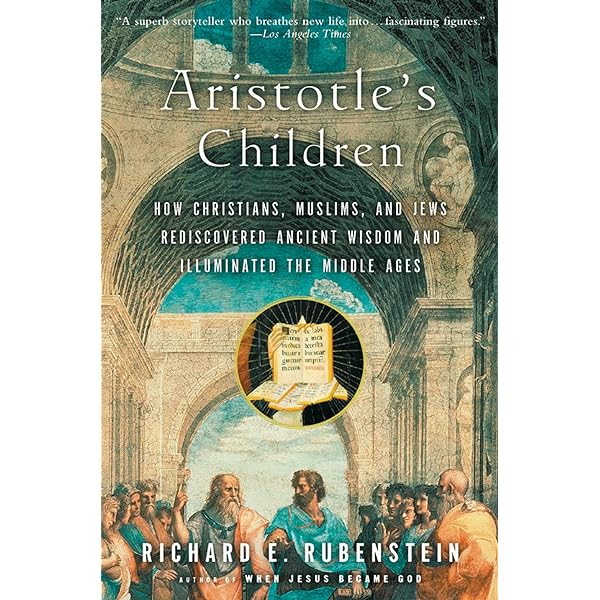
It is becoming more clear even to the popular zeitgeist that history is not just the passage of famous people and impactful wars. That largely seemed like the consensus when I went to public school about 20 years ago. Now, there seems to be a better understanding that history is not just the movement of peoples, but also the movement of ideas. Older generations were convinced that is was the movement of men (and I choose here deliberately a slightly misogynistic phrasing, as my father would) that shaped history, while in truth it is much more the movement of ideas that shaped the modern world.
So as a case in point comes Richard E. Rubenstein’s Aristotle’s Children. It tries to illuminate how it was that Aristotle was reintroduced into Europe after being last in the early dark ages, then goes on to show how the wide spread reading of Aristotle impacted European history, and certain chiefly influential thinkers thereafter. It follows the work from its rediscovery in Muslim Spain all the way to modern times, stopping often to go into the political and societal influence that Aristotle had after being reintroduced and reread, banned, held up, etc. Christian Europe did not seem to have held Aristotle in all that high regard when Christianity took over and became the dominant force. This much I knew already, but I did not know just how tumultuous its reintroduction were, nor to what extent the ideas of Aristotle were so at odds with Christian theology.
In fairness, other reviewers on Amazon have nitpicked the exactitude of Rubenstein’s description of how Aristotle came back into Europe from the Muslim world, but I didn’t find that their criticisms took away from the overall validity of the work. This is just to say that if you are already an expert on this topic, maybe this is not the book for you.
But for the rest of us, the book has merit. The author writes clearly and accessibly, and gives a pretty good explanation of who all the people he brings up are, and how they were influenced by Aristotle throughout the ages. History was never my strong suite, so I found the book to be pretty interesting. The author as well did a lot to make what could be a very dry and academic topic pretty interesting. There is merit to this as well.

 Failures in Polymathy