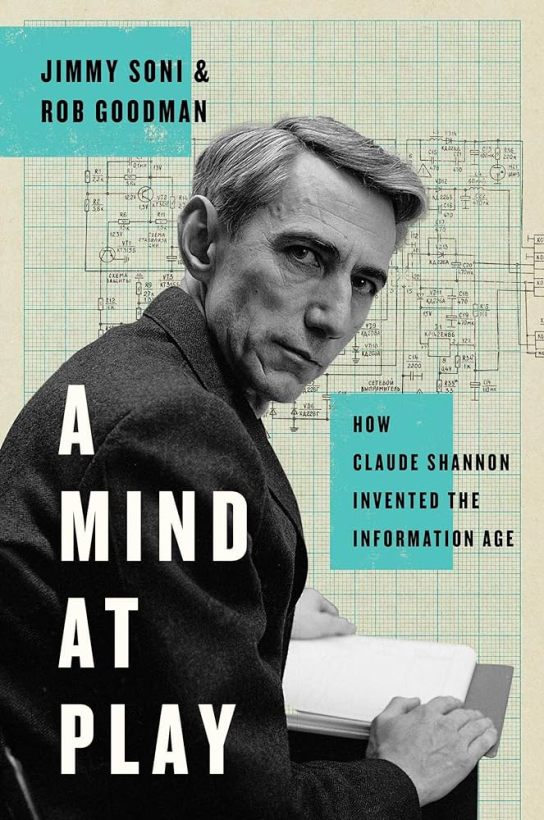
When I finish reading a book, I don’t research it like a normal person. I go to Amazon and read other people’s reviews. These reviews are often less than worthless. I would be just as well served going to a bar, having several drinks, and asking a man wearing a stained shirt and a funny hat about his opinion about what I just read. I might be some kind of punishment, but agreeing or disagreeing with the various opinions therein does help me think about my own. A lot of the low reviews didn’t seem to get Shannon’s importance – how it was, as the subtitle puts it, that he “invented the information age”
The reviews also made me think of my days as a Master’s student, when I was first forced to read Claude Shannon. I remember really enjoying it, despite the fact that his field (information theory) and my own (Semiotics) only overlapped marginally. Compared to the other garbage I was reading, Shannon was fucking legible. Being a good little scientist, he actually tried to write things as if communicating his ideas was the fucking point, while everything else I read was written in that lovely post-modern period where those two or three good ideas anyone had was obfuscated in text walls designed by Daedalus to keep our minotaurs of understanding from seeing the light.
Even if you do not know who he is, Claude Shannon is part of the reason you are reading this right now. That is not in dispute. I am not a mathematician enough to explain how, but his work lead to insights that made digital technology possible. The book does a fair job of helping you understand the relationship between the world as it is now and Shannon’s work to get there. In that respect, I truly have no idea what some of those Amazon reviews were on about.
But there was a criticism of this book that I do think might be somewhat valid, despite my reading it from a 2 star review on Amazon. The subject matter just is kinda boring. To unfairly compare this story to Caravaggio’s, one had a life shrouded in mystery and speculation, while living in some pretty interesting times to begin with. Shannon, on the other hand, lived a pretty tame life, just him, his family, and his genius. He was lucky enough to live in a time where Bell labs just kinda threw money at him because he was brilliant. I think my enjoyment of this is easily linked to the fact that I knew it somewhat. The papers I read were all by “Shannon and Weaver”, and so I was school-boy giddy when Weaver came up in the middle parts. But the book isn’t that interesting on its own.
After reading this, I thought anyone could pick up Caravaggio’s biography and enjoy it. But Shannon’s biography reminded me of a Warhammer novel – you only really enjoy it if you are already familiar with the lore. If you aren’t, you may have a bad time.
Those Amazon reviews, however, are worth the trip. Just for the laughs:
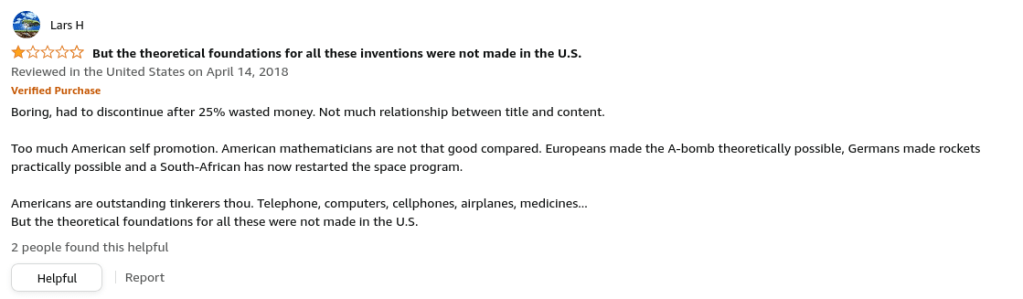
Thanks Lars, for the most ignorant shit I have read all year.

 Failures in Polymathy