Alright, I decided to try something different.
I posted some of my previous ‘did not finish’ posts here, always with a bit of hesitation. I mean, it is hard enough for me to write posts about the books that I actually enjoyed. What chance is there for a the ones I disliked enough to give up on. Still, I will make an attempt to write a line or two about what I gave up on this year.
The Philosophy of Grammar – Otto Jespersen
A leftover book from my career in ESL. It’s a fine book if you really need to get into the weeds about some grammatical point. Not an exciting read other than that.
Gladiator-At-Law – Frederik Pohl and C. M. Kornbluth
A very sad DNF.
Pohl and Kornbluth wrote The Space Merchants, a book that gets talked about a lot. Weirdly enough I used to listen to a cyber security podcast (don’t ask why) and one of the hosts talked about this book incessantly. The Space Merchants is well written, entertaining, memorable, and perhaps unfortunately eerily prescient about describing what is a rather accurate description of the evils of modern marketing and modern day commercial ploys. It makes a lot of Top 100 sci-fi novels. But you don’t hear much else about the two author’s other collaboration. The Space Merchants has a sequel which, so far as I can tell, no one has ever read. Pohl became something of a sci-fi giant. Kornbluth died at a very young age, and didn’t leave all that much of a sci-fi legacy.
Gladiator-At-Law is another one of their collaborations. It also appears to be a book no one has read.
It seems to be a book about corporate lawyers. That’s about all I could make out. The book bored me from chapter 1.
For the life of me I simply could not get into it. At some point I realized I was just turning the pages and not taking anything in. I bought this on Kobo for very little, and so I can always upload it onto my device and give it another whirl in the near future. But for now, I need to move on.
Il Mercante d’Immortalità – Paolo Broccolino
Italy is not all that rich with science-fiction, but some does exist. Whenever I go to my local Feltrinelli, I mostly just find translation after translation of sci-fi books from other countries. I have been telling myself that I would put a little more effort into finding and reading more Italian sci-fi, and this was my first attempt at it.
It didn’t go well.
For the lazy, the title translates roughly to ‘the immortality merchant’. Cool idea. It begins a bit bildungsromans going as far back as his parents life. He then suffers an accident that fundamentally changes his personality, enough so that he considers himself two different people before and after his childhood accident. The personality after the accident is singularly focused, and perhaps autisitcally asocial, and ultimately gets accepted into MIT and then goes into a career in the sciences. His university roommate meets up with him at somepoint to tell him that the personality shift he experienced during childhood was the result of his being selected by some kind of outside higher power, that is compelling him towards certain actions, and that there is a whole secret society of individuals like him. A chapter or two later, and our protagonist has cured mortality, and made himself a billionaire in the process.
That was the first 25% of the book. There were some lines about RNA and using a virus to modify people’s DNA, but whatever science there was here could fit on a small napkin. Someone who reviewed this on amazon called it hard scifi.
WHAT?
The magic of this book was that it somehow turned me into my university writing professor, as line for line and paragraph for paragraph I found myself muttering ‘show, don’t tell’ to my kobo. This author really does just plot dump this whole book on you. I got bored at about 25% of the book, and DNF’d right there.
But I am stubborn, and so I read a few lines from each chapter till I finished the book. Somewhere around the 50% mark, the protagonist was now in space, because I guess why the fuck not. He was also at this point in the narrative about 200 years old, and I couldn’t help but wonder how the RNA technology kept him protected from skiing accidents, car crashes, random lightning strikes, and all the other non genetic ways people have of dying.
This book seems to be well received, and it is praised for its writing style. Reading that sent a shiver down my spine, and filled me with existential dread. Maybe I am the crazy one?
I read this in Udine, a city in Italy proudly holding the highest rate of alcoholism in all the country. It is socially acceptable here to start your morning with a nice 8AM glass of white wine, which is what reading this drove me to.
Interesting Stories about Curious Words – Susie Dent
This will be short, as this book isn’t so much a DNF as it is a DNBTR – Did Not Bother To Read. But that reflects more on me and how I read then it is any kind of reflection on Susie Dent, her scholarship, or this book in particular.
Let me explain.
Susie Dent is a lexicographer and an etymologist, which are two things I really like. From reading the introduction to this book, it is clear that she is erudite, and her wikipedia page shows that she is well credentialed and very successful for a linguist, being featured rather heavily on English TV.
So why didn’t I read this book? Well, it’s just the kind of book I find hard to sit down and read. It consists of short little paragraphs about curious terms. In other words, it is more of a dictionary (etymological and standard) than a book you sit down and read. I can’t read this for the same reason I can’t sit down and just read a dictionary. I know that some people can and have, and I myself used to when I was a kid (the pre-internet world was fucking dull for lonely friendless kids) I did look through it, and was delighted to learn that English’s bizarre raining cats and dogs has an origin, and that my mental definition of to bite the bullet was actually wrong. I enjoyed browsing around this book, I am glad I purchased it, but for my entirely subjective criteria of what reading is, this book simply isn’t that.
This would be a lovely book to have in a home, resting on a coffee table where one can pick it up and browse through it when bored and use it to look up words when needed. But I am a vagabond, and the completionist in me wanted it off my already too full Kobo. Were the Kobo a more functional device with a proper search function and better reactivity, I would keep it on my device for this purpose. Maybe in a few years if I buy another Kobo, I will opt to do this.
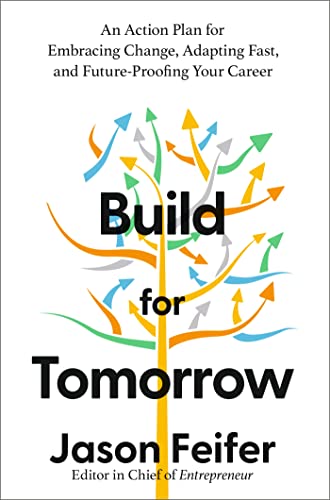
Build for Tomorrow – Jason Feifer
Jason Feifer once had a great podcast called Pessimists Archives – where he explored the history of the negative reaction to new changes in society. I came across it many years ago, and found it pretty delightful. It was a great counterpoint to when you here people disingenuously say (like the guy in the documentary The Social Network who claimed there was no hysteria when the bicycle was invented) that we are living in a time with unique technological problems that we should be hysterical about. Of course, Socrates himself believed that the invention of writing would bring about the downfall of society. Society has somehow soldiered on.
Feifer would later rebrand the podcast as Build for Tomorrow, and focus much more on the type of self-improvement bullshit that one finds on LinkedIn. I stopped listening at some point, and gave up on podcasts altogether some time later.
This book is more of that. It falls in the category of self-help. i think I read the first 20%, and then decided that I didn’t want to bother. Is there some good advice here? Yea, probably.
Moby-Duck: The True Story of 28,800 Bath Toys Lost at Sea & of the Beachcombers, Oceanographers, Environmentalists & Fools Including the Author Who Went in Search of Them – Donovan Hohn
A non-fiction account of the rubber duckies that were lost at sea, and a person who became obsessed with tracking them down, and discussing oceanic/shoreline cleanup in the process. I thought this would be more interesting that it was.
Dungeon Heart: The Singing Mountain – David Sanchez-Ponton
This is litRPG. Whatever that means.
I have met young people who want to write, despite never having read a novel to completion. Their work is often fueled by the other media they consume, and it produces very sub par work.
This one seems to be fully fueled by a video game. I think that could be interesting, but this was so poorly written that I couldn’t bear it.
The Quantum Thief – Jean le Flambeur – Hannu Rajaniem
I probably will need better selection criteria for what I read. I think I picked this up mostly because the writer was Finnish. I think there was just a vague sense of not having ever read anything by a Finn in my life, and thinking “well, this sounds cool”. I like the Finns (I spent two very fun years of my life in Estonia where I met a number of Finns who wanted to do their education in a country that wasn’t their home, but was similar enough to it, much like Italians who go study in Spain), and I like the idea of a heist book. But this just never cut it for me.
I also had something of a gripe with a term the author used. Much as I hated the ‘vomit zombie’ that came up in Leviathan Awakes, Rajaniem gets a little too much mileage out of ‘combat autism’, a seeming superpower some characters turn on at will to help them with the naval battles spaceships repeatedly have in this story. I think I get it: in his books on writing, Sam Delany talks about how you should could fighting scenes short and a bit terse, as violence is usually swift and too chaotic for many people to follow. So something needs to happen to let the characters manage the chaos of trying to control a ship launching missles at another ship while trying to in turn handle the firepower of the enemy. I guess. And yet, it is a bit hard for me swallow, as it pretty much just reminds me of my non-verbal and not very functional autistic nephew, who obsessively rides the Stockholm metro when he isn’t stealing the assigned number plates of his apartment building’s parking garage or running up and down the stairs a determined number of times. We don’t understand either the brain or autism all that well yet, and some people see the occasional autist savants and wonder if there isn’t something to it. But ‘combat autism’ to me felt a bit too edgelord, and I am reasonably sure that were such a thing ever to exist, a marketeer would come along with a more apropos euphamism for it. ‘Vomit zombies’ thankfully disappeared by the second book, but I had no desire to keep up with this one, much less sink myself into the next.

 Failures in Polymathy