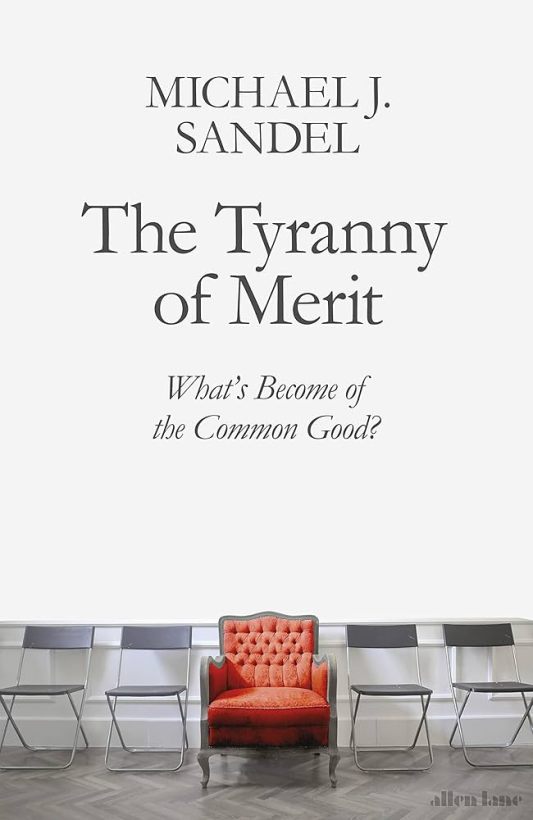
I had a certain apprehension before reading this book.
For a few years now I have been hearing people belittle the concept of merit, and notably Meritocracy. “Meritocracy doesn’t work” is often how this is phrased, often just before pointing out some aspect of our modern society where, ultimately, meritocracy had been usurped. This is patently ridiculous. If something does not meet the criteria of a meritocracy, its not so much that it has failed, but that it has been mislabeled. We would laugh our faces off if someone were to say “Fairness doesn’t work,” and we would point out that you have either achieved fairness of have not, and if a situation isn’t fair, it’s not that the principles of fairness are at fault, but that you have not done the work to achieve said fairness. I feel ridiculous having to explain all of this, and the title of this book gave me those exact vibes. This is the apprehension I came into this book with.
I was wrong.
I think this misconception stems from the sound-bite-ification of our world. People don’t seem to have the time or the mental fortitude to lay out arguments that actually make sense. Thankfully, the author dispels these very oversimplified lines of reasoning early in the book:
“In an unequal society, those who land on top want to believe their success is morally justified. In a meritocratic society, this means winners must believe they have earned their success through their own talent and hard work.”
“The problem with meritocracy is not that the practice falls short of the ideal, If that were the problem, the solution would consist in perfecting equality of opportunity, in seeking a society in which people could, whatever their starting point in life, truly rise as far as their efforts and talents would take them. But it is doubtful that even a perfect meritocracy would be satisfying, either morally or politically.”
“Morally, it is unclear why the the talented deserve the outsize rewards that market-driven societies lavish on the successful. Central to the case for the meritocratic ethics is the idea that we do not deserve to be rewarded, or held back , based on factors beyond our control. But is having (or lacking) certain talents really our own doing? If not, it is hard to see why those who rise thanks to their talents deserve greater rewards than those who may be equally hardworking but less endowed with the gifts a market society happens to prize.”
So here is something I can understand. The problem, Sandel argues, isn’t just that we don’t live in a where people are hired by their merits, but that we proportion to large of the rewards of our society for a certain class of people that do not merit it. We know the statistics: online memes frequently point out that some of the highest earners in our society are basketball players and OnlyFans models. CEO’s once took home 30 times the average employee of their company, and now it is closer to 300 times that amount. Elon Musk is a fucking charlatan, and the richest piece of shit on the planet, and the only thing he has actually done is designed the ugliest car on the face of the earth.
I feel like I still might hate this opinion. When I hear people talk about meritocracy, I still tend to think about online arguments, where people hiding behind anonymity tell you that such and such a person only got their job because of the gender or race, and not because of their merit – and thus ‘meritocracy doesn’t work’. People on the other side of the political spectrum argue that the lack of a determined quantity of people of certain race or gender in certain positions reflect that fact that ‘meritocracy doesn’t work’. I do tend to hear this more from the left than the right. What I never hear, is Sandel’s arguement, and this saddens me because it is the one arguement on the subject that I agree with. It is not meritocratic that an OnlyFans model make more in a year than I will in lifetime – and it is equally unfair that one such model makes that much while hundreds of others doing effectively the same work starve.
This book made me learn that something I thought was simple was actually more complex. But it also reinforced the notion that, unfortunately, most people are still wrong about it.

 Failures in Polymathy
People do not rise on merit but because of their ability to scam others into believing they are competent.
Think Hitler who turned an entire nation into sociopaths, who didn’t rise to power based on merit, but, by scamming the German people into believing that the Jews were to blame for their nations problems.
LikeLike