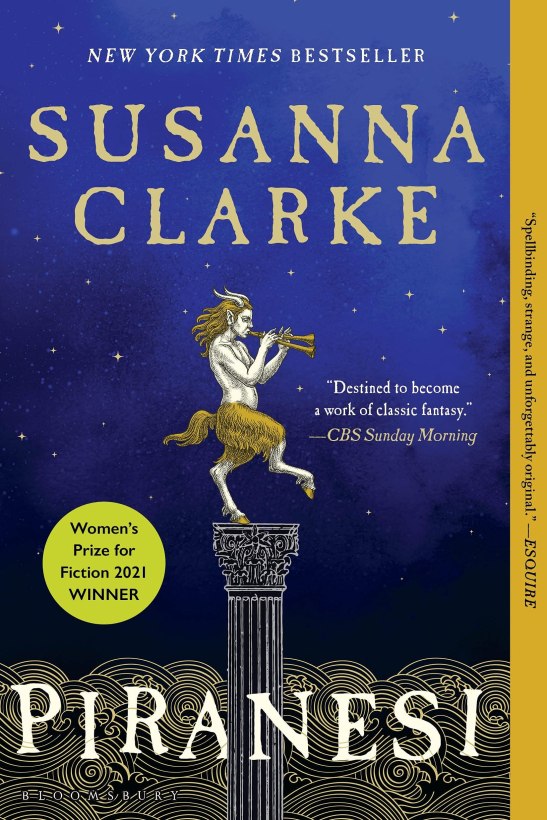
Susanna Clarke wrote Jonathan Strange & Mr Norrell, and no one is going to take that away from her. I didn’t just like that book, I consider it to be one of the very few five star books I have ever read. It’s one of the few books that made me say “Alright sure, I can give this fantasy stuff another try”. That was a book of which I really cannot say enough nice things. It seemed like after she wrote it Susanna Clarke took a much well deserved break from novel writing. Frankly, if anyone deserved to rest on their laurels, she did. I imagine that she her self recognized that writing a book that was that well enjoyed was a trap of sorts (Imagine how Joseph Heller received so much grief because no book after Catch-22 was as good as Catch-22), because whatever you next published, short of being as magnificent as the first, one be criticized for not being Jonathan Strange & Mr Norrell.
Piranesi isn’t Jonathan Strange & Mr Norrell. The book was doomed to my scorn from all the halting and clarifying conversations need when I tried to ask some friends who read it before me if it was about Giovanni Battista Piranesi, whose work I have admired for years. Alas, it isn’t. The influence is there for those who want to see it – the mysterious house this book is set in is clearly influenced from Piranesi’s work, likely the pre-Eshcer Carceri. But even there the descriptions always felt muted, particularly compared to how Clarke made a Cathedral writhe with magic to bring Gargoyles alive in Jonathan Strange & Mr Norrell.
This review is starting to feel like an act of cruelty. I don’t think I meant to do that.
Piranesi, that is Clarke’s Piranesi, isn’t devoid of virtue. It’s fine, but it felt like the left-overs after a really good meal. I actually put something else down in favor of reading this instead. She creates a simple mystery that is resolved in a satisfying enough way. But I really do not think that this slim tone is playing up to her skills. What I wanted from this was too watch her leisurely build a world, more and more complex with each page. At the end of it all, Piranesi felt really muted. The villain felt muted, the hero felt muted, the setting felt muted. The setting seemed like it was trying to be the star of the show, and for me that never makes for a great story.
Ok, but seriously, imagine that you read a book called “Van Gogh”, which was in no way related to “Van Gogh”.

 Failures in Polymathy
A lot of what you felt missing can be attributed to Clarke’s health problems. Including the long pause after the publication of Jonathan Strange and Mr Norrell. None of this went the way she wanted it to go. Read her interview in the guardian where she talks about chronic fatigue syndrome.
LikeLiked by 2 people
Thanks for bringing this up. I am very much guilty of not doing this for fiction, and not doing it enough for non-fiction. I tend to think that a work should stand on its own without outside influence, although I am not always sure how fair that is to an author.
LikeLiked by 1 person
seen as a psychological portrait of Piranesi, the main character, I thought the book was brilliant, but if you approach this mainly from the worldbuilding/mystery angle, it might disappoint a bit.
LikeLiked by 1 person
Yea, I feel that the character just never resonated with me all that much
LikeLiked by 1 person
for me the power of the book became clear in the final pages. that made me rethink it entirely
LikeLike