This year I have decided to tear into more comics and graphic novels. This was at least partially motivated by Jeroen Admiraal over at A Sky of Books and Movies, and partially beause they are easier to read in those few precious hours before I go to work.
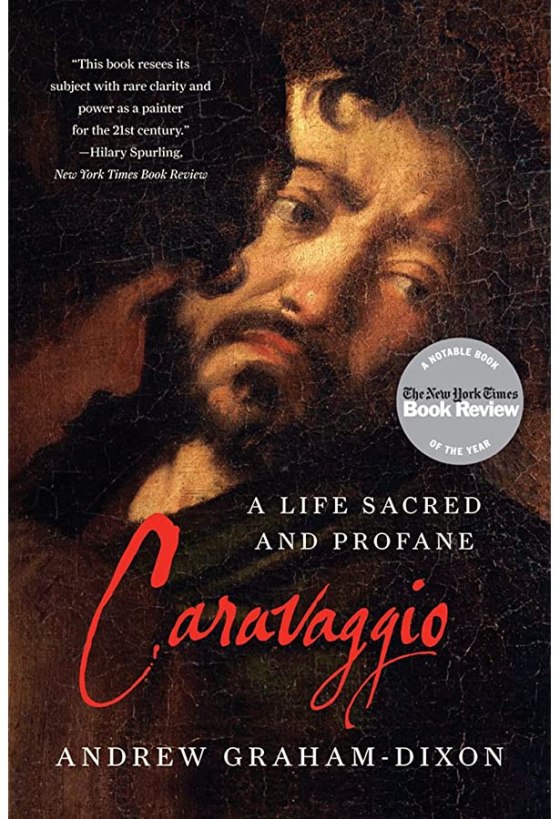
This led me to my local bookstore when I was visiting home, and to great disappointments: years ago, I would go to bookstores and find a rich collection of uniquely Italian comics and graphic novels. Now, the shelf seemed to be filled with all the same Marvel and DC garbage one finds in the US. This is something of a great shame. But as it were, I found one interesting title – Ernesto Anderle’s Caravaggio. I then also recalled that somewhere, I had a very similar title by Artist Milo Manara, and a big-fat biography by Andrew Graham-Dixon titled Caravaggio: A Life Sacred and Profane.
Let’s go through some of these names one by one, sort of.
Michelangelo Merisi detto Caravaggio
Caravaggio is perhaps one of the most important art figures in history. Some call him the father of cinematography, for good reason. Caravaggio was the first of the painting ‘master’s’ that I really appreciated. Frankly, I don’t seem to give a damn about Raffaelo, or for that matter even Michelangelo Buonarroti’s painted works, most of which have a grave absence of certain aspects of realism. Caravaggio fixed that: the figures in his paintings looked like peasants and not sculpted Greek gods. When Caravaggio painted Abraham and Isaac, Isaac looks terrified and Abraham looks like a gullible moron. This makes sense to me.
To the person himself, there is a lot of mythology around the person. Much is speculated about him, often using his paintings to come to these conclusions. The general gist of it is that he was likely a turmoiled and traumatized iconoclast, but also something of a rash and violent person. To what extent this was his nature vs to what extent this was from the fact that he worked with lead all day (and likely from an early age) is unclear.
Milo Manara
Milo Manara is a pretty prominent Italian artist, who has done a number of comics. He also walks proudly into the stereotype of Italians being thirsty little boys with not enough blood for the time-share between the big and the little brain. In few words, the man likes to draw tits and ass, and we have applauded him for it. That being said, he has done a lot of interesting work, many of which I have enjoyed in the past (and many more than what is listed on the English version of his website). He has even drawn for Marvel, and worked with Alejandro Jodorowsky to sensationalize the story of the Borgias.
Caravaggio by Milo Manara
(Read in Italian)
I found out only later that what I was reading was some kind of abridged version of the work. That made the experience pretty bad from a story point of view. Certain character relations were not fleshed out nearly enough. Caravaggio seems obsessed with ‘drawing the people!’ but we are never shown why this matters to him. Though Manara does show us how Caravaggio was influenced by witnessing executions, it seems almost like a detail, and not like Caravaggio was haunted by such witnessings (we will return to this later). The detail that Caravaggio killed a man during a tennis game (a penny for everytime I’ve heard tour guides say over…) seems to be glossed over.
But, holy shit, the art.
Ok, let’s put aside that every woman and most men in this are drawn in a perpetual state of lust and ecstasy. Let’s focus on how well Manara brought Rome to life. But not any Rome, he went with Piranesi’s Rome. Manara really brought out the fantasy world of a collapsed empire and the impoverished people living in its ruins. This is where fantasy (the genre) comes from. And it is gorgeous.


I go nuts for this shit. Piranesi is another favorite of mine, and so the intersection of the two was welcome. When I found out that I was reading the abridged version, I decided that I would ultimately need to track down the whole damn series, really to get more of this. And maybe it’ll cure some of the storyline issues.
Caravaggio by Ernesto Anderle
(Read in Italian)
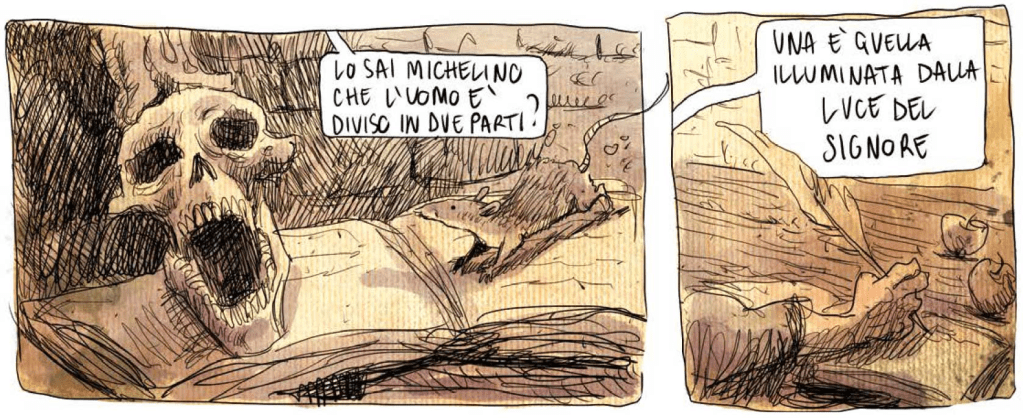
I didn’t know anything about Anderle when I dove into this, and so I can skip the biographical section here. This is the better graphic novel. Anderle elects for a sketchier, grimier style, but it fits in with the story a lot better than Manara’s meticulousness. But what really stands out is that there is a better story here (again, I understand that I read an abridged version. But I’ve also read enough Manara that I wasn’t expecting to be blown away), and I thought the style Anderle went with really fit the story that was being told. Caravaggio here is a hollow, haunted man, on the run (literally and figuratively) from the past. The story featured heavily on hallucinatory dreams Caravaggio had in the period just after leaving Rome, which was just where the Manara one had left off. Again, I feel like Anderle’s style fit the theme well
I would love to share some of it with you, but I found surprisingly few samples of it online, and by the time I got to writing the review I had abandoned the book somewhere.


I enjoyed this enough that I will certainly track down more of Anderle’s work. It certainly beats reading a Marvel comic.
Caravaggio: A Life Sacred and Profane – Andrew Graham-Dixon
(Read in English)
This is not just a biography, it’s a history book. You can look at the sheer girth of this book and know immediately that this thing is thorough. It doesn’t just tell you when Caravaggio was born, but tells you about the battles that took place between the Ottomans and the Venetians around the time of his birth that influenced those times. It goes into why the Spaniards were increasingly interested in the Lombardy of Caravaggio’s birth around that time.
Your reaction to this book is likely going to involve how you relate to the above. You aren’t reading about Caravaggio alone – you are also reading a dozen or so pages about all the people who were relevant to his life. Many of these were his patrons, and thus some kind of mover and shaker from Roman or papal history. It can be a lot at time. You may also get a dozen pages on one painting, with many of those pages focusing on the representation of reptiles in renaissance art.
Yea, it is thorough. It is also pretty niche.
I can’t recommend getting a physical, dead-tree copy of this book if you can. Most biographies include a small section of glossy photos inserted somewhere in the middle of the book, usually showing pictures of the subject from their life. This book has a few of those, but instead it shows both the paintings that Caravaggio produced, as well as the paintings that influenced his paintings. I was unfamiliar with the latter, and they were a great supplement to what I was reading. It made me glad to not be reading a digital copy.
Book reviews need context much in the same way that biographies do. Perhaps it is just because I am interested in the topic, but I didn’t find this information deluge to be unnecessary. This work is great at dispelling misconceptions – like that Caravaggio was born at the cusp of the change from when painters were being treated merely as workmen (low people who used their hands) to capital A artists. This happened around the time of the publication of The Lives of the Most Excellent Painters, Sculptors, and Architects by Vasari in 1550 (Caravaggio was born in 1571). There was (and, alas, still is) a homophobic notion that Caravaggio’s personal roughness and violent nature had something to do with his being gay. The book goes into dispelling that. It also makes efforts to elaborate what Caravaggio’s sexuality actually was.
But the overwhelming majority of this book seemed not to really deal with Caravaggio per se. It dawned on me only while reading it that there likely isn’t very much documentation to go on. It was unlikely that anyone really knew that Caravaggio was going to become a household name – or a person who now has an adjective named after him to describe his style. The actual biographic information does feel thin, but considering to what extent the rest of the book seems so absolutely saturated in detail, it is likely that this is all we can get with Caravaggio. This is a pretty great shift from the embellishment you get in the graphic novels, and it shows that the writer respects history. But at times you do with for some elaboration: after a paragraph description of how Caravaggio might escape from a Maltese prison, we get the following sentence:
“Somehow, Caravaggio did indeed manage all of this.”
Historical accuracy is sometimes rather underwhelming.

 Failures in Polymathy

Hey, thanks for the link! I am glad that I inspired you to read some graphic novels. That comic by Milo Manara looks amazing.
LikeLike
No worries. Manara is great, if not a bit sex obsessed. Check some of his stuff out, if you haven’t already
LikeLike