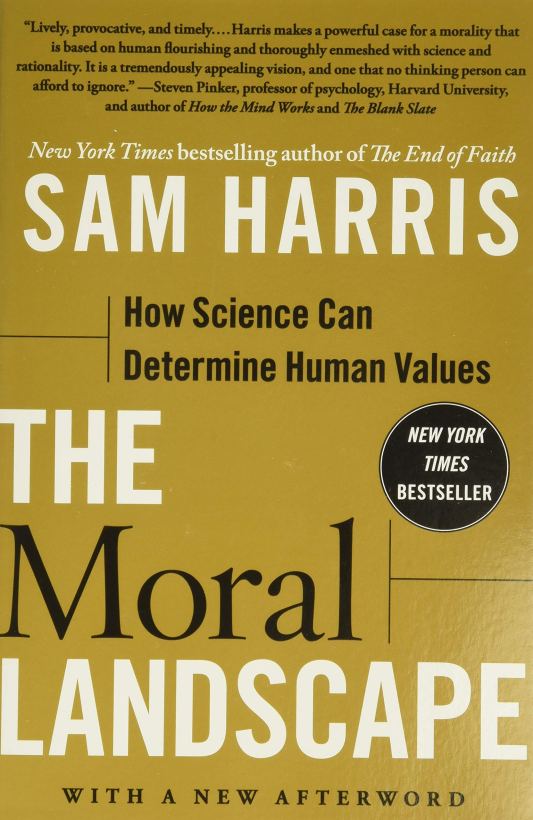
When Sam Harris came into prominence in the mid 00’s, he came to my attention through a group of fellow students so smugly atheist as to pretty much be the exact stereotype that is likely in your head as you read this. They were in fact so smug that even now, when philosophically I agree with them, I can still look back and say I dislike them. Sam Harris has perhaps unjustly picked up some of the residual animosity I hold for those students. Still, I hoped to enjoy this book. The underpinning ideas behind this book are interesting, and there is something to say that if a solution to the harder problems of ethics are ever to be solved, it will be done so by looking at things from a sort of pragmatic or consequentialist lens. Other people have spoken about the ideas on this book in ways that support the ideas well.
In fact, if I had to explain the ideas, I prefer their framing. The principal idea is that we can make certain statements about how we should live ethically that are based off of science and other forms of sound and valid reasoning. The analogy made by this book itself is that in the same way that we can say something akin to “knowing the battery acid is harmful to humans if ingested, we ought not to ingest it”.
And with that one line, some of you already see what the problem is here.
The analogy could continue to ethical statements: “knowing that murder harms another individual, we ought not to murder”. No matter how simply I have tried to lay that out, there are a number of underlying assumption and presuppositions I have glossed over. And frankly, so does Harris. This is pretty unfortunate for both of us.
Philosophy is actually very hard. It’s also criminally underappreciated in modern society. I feel like the person to truly popularize it to the masses will go down in history as a kind of savior. But in the mean time, people with a marginal understanding of it (such as myself, such as Harris) will insist on having their say. The difference being that I will do so without much resounding effect. Harris will get his book published, and frankly it will get many more eyes than the pretty simplistic ideas in it seem to deserve.
I thought the book was mostly ok, and its major distinction being a lack of the true sophistication I had encountered in other philosophy books. And then I got to the last chapter, and annoying little section on Religion. Again, he is mostly preaching to the choir, but reading the last section made me feel like he is letting his hobby horse blind him. It has become the hammer that lets him see the whole world as a nail.


lol, smug students. the way of the world.
LikeLike