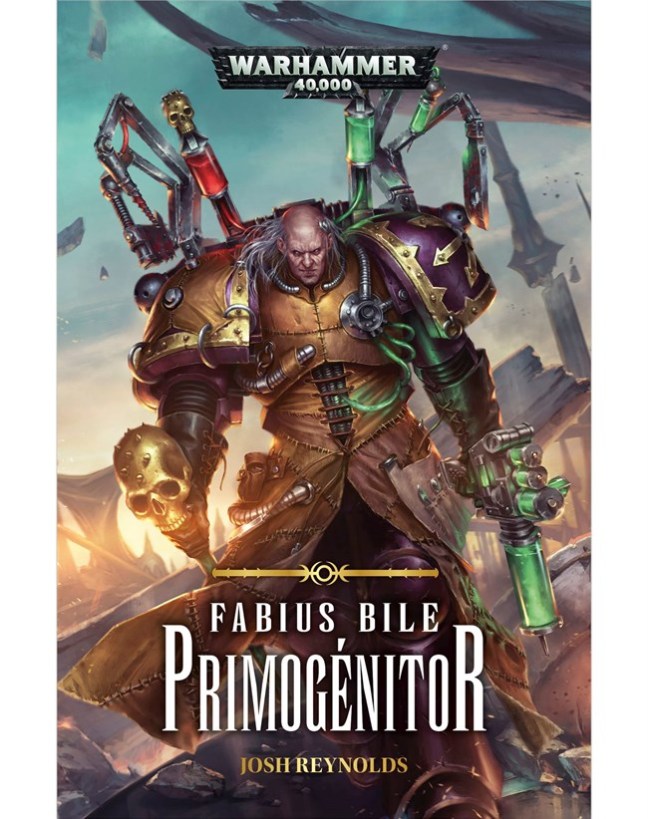
I find traditional ratings to be a bit silly. Particularly with books. What is much more useful is to give context under which a thing comes to be enjoyed, and why. Or in some cases why not.
Sometimes you want a nice steak, and sometimes you roll out of bed with a hangover and tell yourself “fuck it, I may as well ruin the whole weekend and get McDonald’s as well”. The literary equivalent to this phenomenon, are the Warhammer novels. Although this analogy might fail in that I have met far fewer people who want to convince me that McDonalds is good than want me to think that the these Warhammer novels are good. But just like the downtown DC McDonalds out on U street in the 90’s was pretty toxic, and somehow the József körút one here in Budapest is surprisingly good, each of these novels needs to be taken on an individual basis.
Warhammer is the theater of the ridiculous played straight. It was designed by a group of people trying to one up themselves, till what was left was a science-fantasy universe where literally everyone and everything was some kind of superlative. It’s great, if you are able to not take it so seriously. The titular character of this series, Fabius Bile, is a great illustration of this: in a universe where there are literal gods – literal dark gods vying for your soul – and those gods have demons manifested in reality, Fabius Bile is so utterly atheist that those very same demons are weakened by his presence and his disbelief. You also have walking sarcophagi with guns, a wire one molecule in width being used as a weapon, and blades the vibrate across dimensions.
So yea, it’s pretty Looney Tunes, but all the while played straight. It’s an acquired taste.
Fabius Bile is a cartoon villain. He doesn’t have a mustache to twirl, but he might as well. Most of the characters in this book or cartoonishly villainous (there is a sort of ‘council of evil’ scene in the first novel that made my outright laugh), but the main characters have enough depth and breadth to have kept me going. Specifically, Bile is a mad scientist trope, doing everything he can to stretch his scientific (and unethical) goals. 10,000 years ago Bile began his career as a military apothecary, and he now has an (evil) goal of saving humanity by its achieving some kind of genetically altered perfection. All the other characters around him are just evil for evil’s sake.
I recently had cause to do a big clean of not one but two houses, and so I opened up some folders on my PC, and found these three guys in a folder of Audiobooks. Let’s go. I assume the above is review enough to let someone know if they want to read these or not, but either way I want to get into a bit of the plot. Potential spoilers below but I’ll try to be vague.
Primogenitor
Forces are at play to get Bile and various other cohorts of evil to attack an enclave of Space Elves so that he can retrieve a kind of space McGuffin. The plot ultimately leads to Bile confronting many conflicting forces, each that seem to have different designs on his destiny. Among these are the Harlequins, a sub faction of the Space Elves who dress like clowns and who fight using cryptic performances. Think of them as a murderous Cirque de Soleil. They too seem to be pushing Bile into a certain destiny. Despite the demons and gods and Space Clowns that seem to be pushing him towards the multitude of destinies, Bile stays true to his characters (and his dogged atheism that insists that the Gods are scientific forces unclearly understood) and refuses them all. Unless he is being played.
We are one book in and I can safely say this series is not for the uninitiated. Do you know the difference between a Word Bearer and a World Eater? No? This book may not hold your hand through it. The whole Warhammer 40k backstory may be needed to get through this.
Clonelord
It was in the beginning of this book that I realized that the author had reused a metaphor from the previous book. It was in an early chapter of this book that I listened as the author had reused a simile that he had used in a previous chapter of this very same book.
Oh-no.
That is exactly the kind of thing that bothers me. I wish it weren’t so, but writing is a craft and you should put some sweat into it. I can kind of ignore the cartoonish plot, but what I consider lazy writing really puts a block on things.
The kinda boring plot didn’t work for me either. The whole story seemed to revolve around people conspiring against Bile, and what he is doing to maintain control of the marauding band he keeps around him. The story is meant to be kept interesting by the fact that Bile has discovered a successful Clone of the legendary hero who his own genetic code is based off of. This is one of those moments that is supposed to be propelling the overarching plot of Warhammer 40k (or at least, it is one of the pieces in motion). But it is a little hard to care for those of us who are not that heavily invested.
Manflayer
The burnout is real, folks.
It was at this book that things began to grate on my nerves. I thought the writing was competent enough, but there were elements that I thought should have been expunged. The villains here are cartoonishly villainous, but as mentioned above that is sort of a tongue in cheek point to this. Here, with some of the cahracters, it started to feel much. The descriptions started to feel like the useless homeric epithets just needed to make a line fit into the rhyme.
The story felt very similar to the last book. Everyone wants Bile dead because he is a pain in everyone’s side. This time the evil space elves are leading the charge, because Bile once was there guest / prisoner, but escaped with some of their secrets. In this book, Bile gave me some Rick from ‘Rick and Morty’ vibes, in that there is always something up his sleeve, because he is too smart for his enemies and always seems to preempt their plans. I was also not sure all the plot points from the previous books were followed through on. If the hints dropped by the circus space elves from the first book were resolved, I just didn’t catch it.
I got the impression that the author had a trilogy in mind by the time he got around to writing these, because of a certain imbalance that existed in the three. This one, for instance, is very action heavy. I tend to agree with something Sam Delany wrote somewhere, where he says that action scenes in books should be used sparingly. Stories with too much action feel like cakes with too much icing – looks like a good idea until you get down to eating it.
And then, there was the last chapter. It served nothing except to further the plot. But not the plot of this book – the plot of the Warhammer Universe in general. Even though it was just largely a few words here and there, but some of the end of this is unintelligible if you are not only into Warhammer, but keeping up with it. From these three books alone, sentences in the concluding chapter like “Guilliman has returned” and “primarus marines” are something you will either need to know, google, or be confused by. The other side of the double edge sword is my fascination with what Games Workshop is doing as a business. I audited business classes when I was in university, and I truly believe what they are doing with their stories as a business is pretty fascinating (original perhaps for a game franchise – I think what they are doing is very similar to how WWE pivoted, but that’s not a story for this book review).
Overall thoughts
Your reading of these books may depends largely on two possible factors: either your ability and desire to go spelunking through the deep, deep caves or warhammer lore, and/or your ability to ignore jargon and get on with the text. I took a hybrid approach , and wondered who truly is able to keep up with all of this. At times certain characters are referred to by a deep lore moniker, and you just have to keep going. Idem when they are discussing the fictitious biology of their fictitious super soldiers, and I just kind of ran past it. Your ignorance on such matters likely won’t break the story. But having read some of the lore, I am not sure what will. Your millage will very much vary. Sometimes, some of the jargony sentences truly felt like they were written by someone trying to actively mock science-fiction.
Part of me hopes that I stop enjoying these novels. With over 600 titles in the library, it already feels like a life time of work. While I didn’t love this trilogy, I am still curious enough about the franchise that I will pick up another few books from this franchise.
…
Hey, at least my house is clean.

 Failures in Polymathy