Fuck off, it’s my blog and I will talk about what I want.
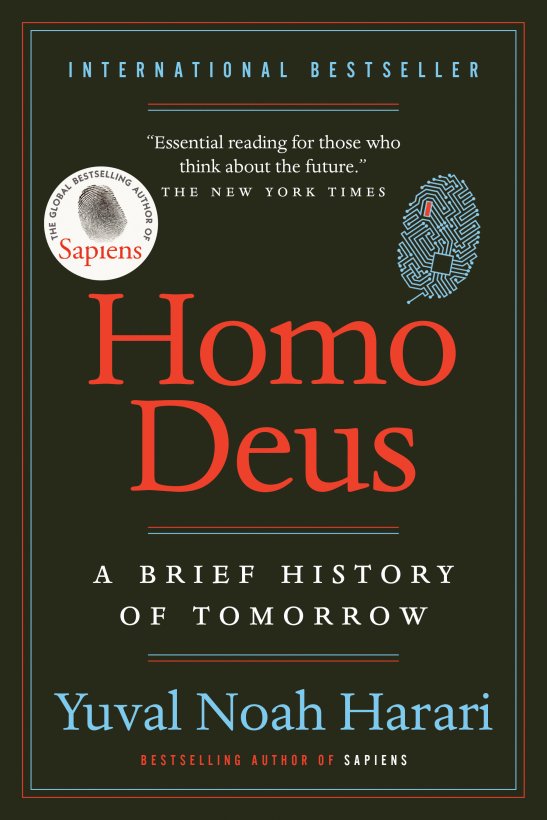
I am writing this on Feb 20th, 2025, and I have not actually finished reading Homo Deus. Over these past few days, Donald Trump is taking over America in the most painfully obvious way. The consequences of this do not strike me as something Europeans should be ignoring. Where will we stand, with our long memories of what horrors fascism wrought last century, were Trump to actually invade Canada, or Greenland, or Panama? Now that he has bowed down to Putin, what will this mean for the conflict in Ukraine.
In the mean time, I am going through Homo Deus. Somewhere in the works of Roland Barthes, you will find the notion that you can’t really read a book in some kind of perfectly objective state. Your reading will always be influenced by things going on in your life. Homo Deus was written in 2015, before the current collapse of civilization and right wing turn that began with the vote of Brexit and the initial election of Donald Trump. It now seems a bit naive in many ways. Here is a quote I found (emphasis my own):
Abraham Lincoln said you cannot deceive everybody all the time. Well, that’s wishful thinking. In practice, the power of human cooperation networks rests on a delicate balance of truth and fiction. If you distort reality too much, it will weaken you, and you will not be able to compete with more clear sighted rivals. On the other hand, you cannot organize masses of people effectively without relying on some fictional myths.
I keep coming back to this in my head. Donald Trump and Elon Musk are lying to everyone about everything seemingly all the time. I can’t seem to find the clear sighted rivals.
Books are a product of their time. I recall buying Chomsky’s Hegemony and Survival back when it was published in 2003, but because I was a bit to young at the time and unwilling to challenge myself, I ended up reading it close to a decade later, well into the Obama administration. Of course, I ended up finding the whole book to be so utterly irrelvant that I was wondering why I was reading it at all. That was the vibe here as well. This book was published in 2015, and considering its breadth, likely written much before. It’s strange to think about how much can change in just a decade, but I guess that is just the world we live in.
Right. So what is Homo Deus about anyway? The Homo Deus in question is the supposed next evolution of human’s that is meant to emerge from our technology. This is a leftover residue from the last two decades techno-optimism, that by my assessment feels all but vanished.
I can’t get away from saying that you likely shouldn’t bother with this book, less you live in a future that wants to understand some of the sentiments of the mid 2010’s. I still like Hirari, as a writer. I can’t exactly fault him for giving a warning and seeming irrelevant a decade on. I might actually grab Nexus sometime soon, and try to get it read in less than a decade.

 Failures in Polymathy
Techno-optimism is alive and well: lots and lots of people still believe we’ll find some technological solution to climate chance.
LikeLiked by 1 person
Fair, but I feel like that is the hope at the bottom of pandora’s box that we must hang on to less we all lose our minds. People seem to be less inclined now to beleive that Elon Musk is going to take us to Mars by… [checks notes] …last year.
LikeLiked by 1 person
my take is to abandon hope, and just try to live in the present.
LikeLike