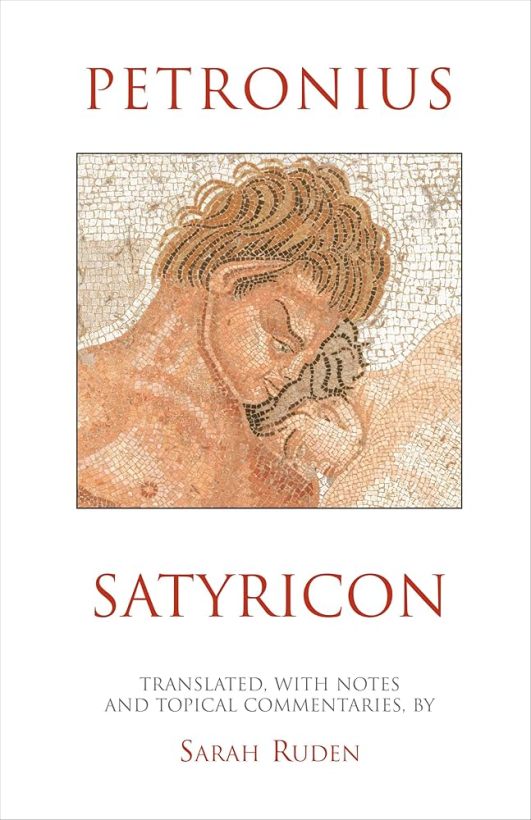
I have two editions of this, and even more if you count the ones that are probably at my mom’s house. But according to voices online, the Sarah Ruden translation is the best, and often used as a book for classics students. This review will be a little bit about the story itself, and a few notes about the translation. I have always wanted to do a compare and contrast of conflicting editions, so here was my opportunity. So I dug out a Pengiun Classics edition from 1965, translated by J.P. Sullivan.
The Satyricon is, by some people’s measure, the oldest novel. I have also heard other answers to that question. It is a bit hard to tell you what this is actually about: there is a former roman gladiator who wanders around looking for his next meal. There seems to be a lot of sex involved as well. It is hard to dig out the meaning because all you get is the fragments of what is left of the original text – the penguin edition gives you some good amount of insight into where and how the various source texts used to compile this come from – but to sum up the ‘plot’ of it, it is highly satirical and highly critical of Roman life, by giving you slight slices into what this Roman life looked, especially when certain lower class people interacted with higher class people. Priapus is also mentioned a fair amount, and there is a fair bit of sex talk in this one. It’s raunchy.
I think I will always be mystified about the fidelity of translations. But even a side by side glance at both editions will key you in on to what extent there is a not a lot of consensus as to what is even going on with this text. Ruden’s version has part 6 of the narrative, the last part of the narrative, begin with section 115. It is titled Croton. In the Penguin version, The Road to Croton is the fourth and penultimate part of the book. It begins with section 116. The work of going through both the translation with a fine tooth comb would be an ordeal that I didn’t engage in (Well, in the end, I got some seasonal work and gave up on reading the Penguin edition. I need to leave in a hurry, and I wasn’t going to lug around either of these books). When you look at the two books, you really become very skeptical that they are exactly the same. I am pretty determined to return to this project at a later date.
But if nothing else, there is certainly a lot of liberty taken in the translation. As evidence, here is the same verse from both translations.
What use are laws where money is king,
Where poverty’s helpless and can’t win a thing?
Even Cynics who sneer are rarely averse
To selling their scruples to fill up their purse.
There’s no justice at law – it’s the bidding that counts
And the job of the judge is to fix the amounts.
– J.P. Sullivan
Vs.
What good are laws, when cash is king?
Can poverty win anything?
The ragged Cynics sell their words,
Yet rave at our crass times – absurd!
A farce! The juryman all know
Which way the auctioned case will go.
-Sarah Ruden
This is also a time to say that I prefer Ruden’s translation. That just might be vibes. But I think there is something to say about the fact that Ruden’s book is the better, at least for my tastes. I like how the notes are at the end of the page, and not the end of the document. It’s the only way I get around to reading them without losing my place in the story, or forgetting they exists. I also find it suspect that Ruden’s more modern translation has a whole chapter (Quartilla’s Orgy) that seems to be unlabeled in the Penguin edition. I will leave you to speculate as to why. Ruden is also more generous with her notes and her thinking on the translation, which I found very helpful. Case in point:
“Carnival Freak” and “carnival” are my rendering of “gladiator” and “arena,” which do not seem nearly strong enough to convey the very low social standing of participants in gladiatorial games. The text is troublesome here, making it difficult to tell exactly what Ascyltos alleges happened.
Having that note is actually pretty helpful. I am the kind of person who doubts, and when I saw ‘Carnival Freak’ I did wonder if Ruden was taking liberties. She was, but she explained and justified her actions. Ruden does this helps you out later when you encounter lines like
“Hamstrung”: the prize was a ham tied up with string.
I have a weird relationship with the classics, having grown up in a book lined home where no one had actually read many of the books that were around. I grew up somewhat skeptical that the books actually were worth reading, and I pick them up and read them every now and again to see what the verdict is. I don’t think The Satyircon is something most people need in their lives. It likely only hung around this long because of some rare grammatical form used only in this text. It is of historical interest for those people who really want to face plant in to Roman history. Don’t bother with it unless you want to obsess.
I didn’t think much of the reading of this book, and then I got to the final essay in the Ruden edition, which she recommends we read last after completing the narrative as a whole. That essays open with “On a first reading, the Satyricon may seem like so much fluff. Petronius is crude, irreverent, and whimsical in his storytelling. But behind the story lies some more serious philosophical issues.”
Damn. Perhaps this could do with a reread in the future.
But if you are going to read it, do get the Ruden translation. Good notes, good translation, good commentary.

 Failures in Polymathy