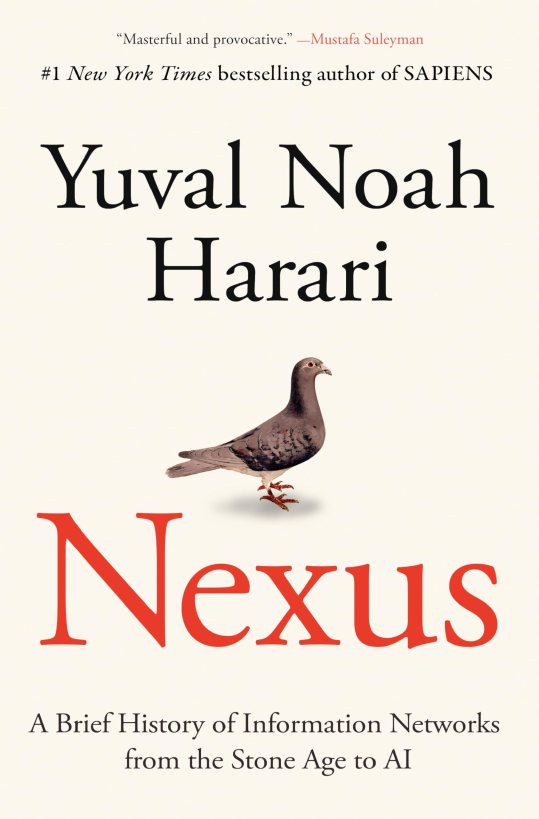
Unlike some recent reads, I know exactly why I read this. My mom asked me to, as Harari is someone she reads a bit religiously. I’ve encouraged the habit, and for the most part I read along with her in the process. What I didn’t get as attached as she did is something I am discovering as I read his books. I think I will have it figured out with his next book, whenever the fuck that will be. As sure as he will write it, I will find myself obliged to read it, so I am looking forward to that.
The book is about humanity’s relationship to information and more specifically information systems. What you think of this book will boil down to how valid and sound you find his reasoning here. I thought it was fine, and I find the model he creates an interesting way of framing the world, especially with the coming of AI. Of course, AI is the point the book seems to be leading to, and I kind of dread even going into Harari’s stance on AI – not for any disrespect to Harari, but only because at this point everyone and their dog has an opinion on AI and there seems to be fuck all concordance. It’s like that metaphor of the blind people trying to describe an elephant, except instead of an elephant its a circle jerk.
Harari dedicates Nexus to “all who love wisdom,” and I think there is something sincere to it. Harari does come across as a person who genuinely respects knowledge, wisdom and institutional knowledge, and also has a healthy concern over the political happenings of the past (…god all fucking mighty has it been a) decade in regards to what it has done to errode people’s trust in institution (and thus institutional knowledge), and the impact that has to be a society that operates with some kind of fucking wisdom.
Post-truth, post-trust, whatever label you want to give our epoch of stupidity, one of the things that has definitively happened is that a permission structure has been given to regular people to doubt institutional knowledge (that permission structure sounds exactly like Joe Rogan “just asking questions”), and as a consequence of this one bit of institutional knowledge that has come into question over the past few years is the actual value of the capitalist system. There seemed to be a whole section in this book that seemed to me to be Harari trying to have a little apologia for capitalism, with cries of “please remember the horrors of communism”. Weirdly enough, it was the most memorable part of the book for me, but also the only part I can remember that gave me ire at what I was reading.
I think Harari has some very good ideas, especially about what the real relationship between humans and information is. I don’t think it amounts to anything, as the utterly moronic “captains of industry” helming the direction of AI would rather sit on dicks and wait for miracles than accept that AI is little more than Homo Gestalt.
Their loss, I suppose.


