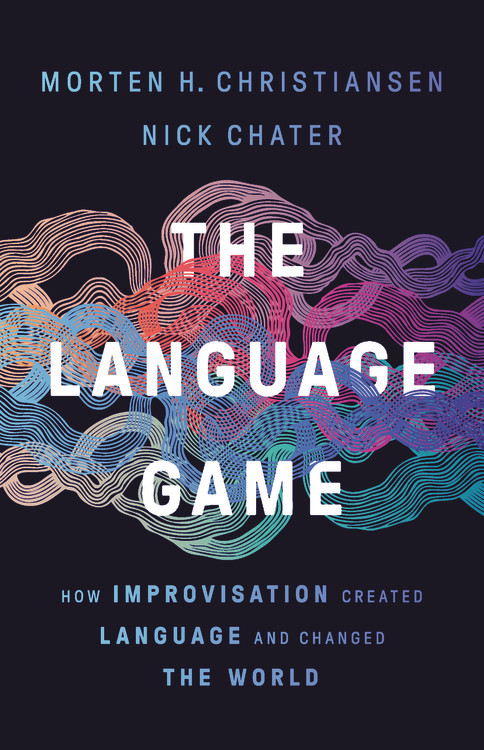
I read books like this for the same reason I go to the gym. In the gym I am not really motivated by gainz or reaching some kind of personal record. It’s pure maintenance, and an understanding that the middle aged person who doesn’t go to the gym will likely become an elderly person with mobility issues.
I am currently a person who know a thing or two about languages. I like being this kind of person, and hope to be this kind of person as long as I keep my faculties about me. And much in the same way that I actually find sitting down and curling a dumbbell to be kinda fun, books of this nature tend to be filled with fun anecdotes about language and language learning, linguistics factoids or linguistics miscommunications anecdotes. All fun things.
For the most part, I just read this kinda stuff, smile to myself, and then write a silly little review here. But every now and again a book pisses me off enough that I find myself actually having strong opinions about it, enough to break my self-impossed 500 word limit/benchmark for these reviews.
This wasn’t a bad book. They didn’t make shit up, they don’t seem to have an agenda, and their opinions are largely in line with my own. If you read this book knowing nothing of linguistics, I wouldn’t feel like you would walk away knowing less about the world. I was greatly annoyed with how polite they were about linguistic prescriptivism vs descriptivism, suggesting that prescirptivism is a valid but minority opinion, when in actual fact it is something that will get you laughed right out of a room with real linguists. The authors are probably two people very smart people in their field – which is cognitive science. No shade to them, but I don’t think they did all the linguistics 101 reading, which may have helped out the project here.
If you have a degree and have written a research paper, you might have done something akin to finding a quote in your reading, and then cited the quote directly in your writing, despite not having read the book. This brand of academic recursion is how a lot of young grad students bloat their bibliography, and the one who say they haven’t done this are lying to you. But the issue comes from the fact that if you do this, you might lose a lot of very helpful context.
In this case, the context was symbolic reasoning.
While reading this, I quickly started to ask myself if the authors had ever heard of symbolic reasoning. Because there were some things that they considered to be puzzling that I was not at all bothered by. The book opens up by referencing the tales of captain Cook and his men, who not having a common linguistic means of communication find themselves communicating by gesture to the natives of the island. From there we get to charades, yes the game. Once can intuit how charades would be useful in this context. You can’t speak to the natives, you point to your stomach, you point to your mouth, eventually someone thinks “hungry”. The authors go on to use Charades to explain a lot. When they need an answer, they use charades. Without justifying or even expressly saying it, they conflate this act of charades as exclusively iconic communications. It isn’t. It can be indexical, and as I will show later with one of their own quotes, it can be symbolic.
This is where the mess begins, and it is a recursive, academic mess where Christiansen and Chater cite Tomasello, another modern day researcher, and one or all three of the people in question seem to have not done their homework:
Vocalizations, he [Tomasello] says , simply don’t have the iconic powers to signal meaning in general: it is easy to imagine making a gesture for “stirring the pot” that others would have no problem figuring out, but coming up with a vocalization to signify the same action seems impossible.
Um, wut? That’s a powerful sentence, if you think that iconicity is the only way meaning is communicated. To me it reads a lot like “Magnets simply don’t have the gravitational force to pull other magnetized metal towards them.” Yea, no shit. But there are other explanations.
In 1867 Charles Sanders Pierce created a typology of signs, and because he was a bit of a nutty christian he did it in threes – the Icon, the Index, and the Symbol. These are a triumvirate of signs, each one conveying meaning in a slightly different way. Notably, there is increased amounts of arbitrariness as you move between the three, with symbols being (definitionally) the most arbitrary.
I am not home and I don’t have access to my books, so I asked an AI to spit out the distinction between these three:
Icon: A sign that represents its object through resemblance or similarity (it looks, sounds, or feels like what it means).
Index: A sign that has a direct, physical, or causal connection to its object—it points to or is a consequence of the thing it signifies.
Symbol: A sign that connects to its object through law, convention, habit, or social agreement, having no inherent resemblance or physical cause.
There is overlap between the three, and one communicative thing can even be all three. On top of that, being a Semiotician requires that at some point in your life you drunkly argue about what of these is which to someone who, if they weren’t being friendly to you, wouldn’t care. I want to demonstrate how the first two can be used in Charades:
Icon: For the word “wave”, I make a wave-like motion with my hands.
Index: For the word “me” I point to myself.
If you are lucky, your uni tells you about Pierce and his trio of signs in your first semester, but not all do. While you get the basics of semiotics in a linguistics program, some decide to simply stick with Saussure’s typology of sign, as it works very well for linguistics.
Christiansen and Chater continue to bring up icons and iconicity in the book, never once mentioning indexes or indexicality, nor Symbol, symbolism, or symbolic reasoning. Every now and again there were sentences in the book that kept making me ask myself if they had so much as even heard of Symbolic reasoning:
Charades can be invented, corrected, and reused on the spot so that a single gesture can indicate a book, a film, a person, or a historical event because it draws on the shared knowledge of the specific players involved—and which charades they have played in the past. It is this ingenuity, rather than simple fixed signals such as alarm calls, that provides the foundation for human language.
In case someone missed it, here is the definition of symbol above: A sign that connects to its object through law, convention, habit, or social agreement, having no inherent resemblance or physical cause. Shared knowledge of specific players is an ad hoc social agreement.
There was a very real sense in which this book was two men showing me a wheel, calling it by every other description, and saying they made a discovery.
In a lecture series, John McWhorter explained it in a way that might be more clear, and perhaps avoids the jargon. One can imagine a mythical Adam and Eve walking around the garden of Eden naming things. They can point to a dog, utter the word ‘dog’, and boom! its now named. Easy for nouns, gets trickier for verbs. But what about a word like through? How would or Adam and Eve come up with a name for that ex-nihlo?
All language, even at its most onomatopoetic, is symbolic.
I don’t know how much longer I want to pull this semiotics lesson by its teeth. Studies in the sciences are difficult for numerous reasons, and why we respect people with Phd’s is partially because we recognize that they are trying to wrap their heads around some very difficult and complex systems. These systems can reach a level of complexity that means that no amount of study allows people to see these systems in their entirety. The writers here have really missed the mark on something that to me feels very obvious.
I have a book recommendation for these guys:
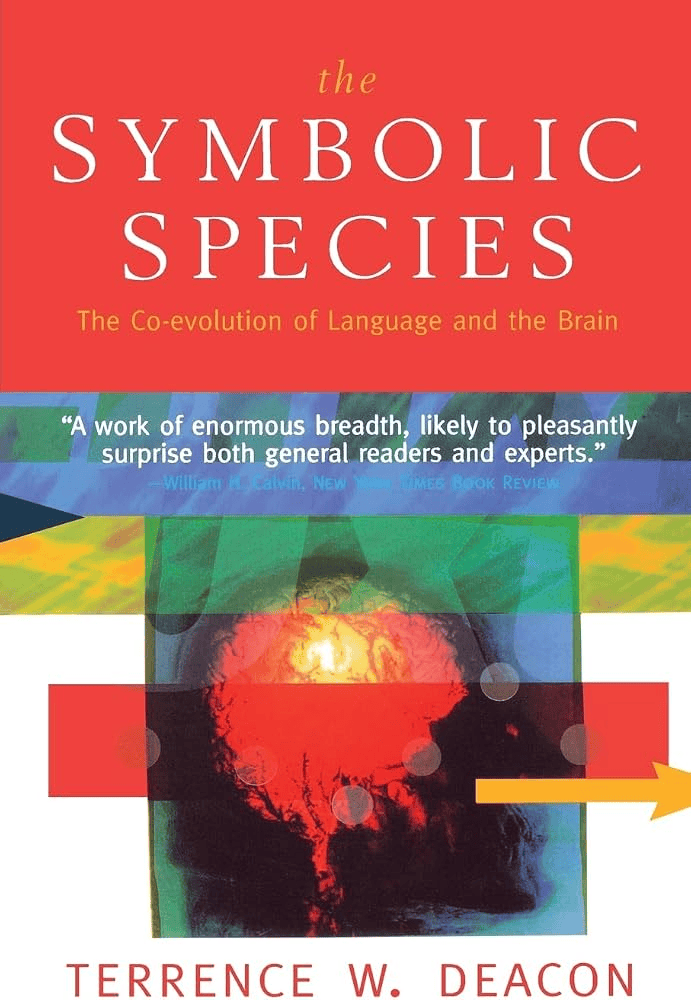
It’s listed in their footnotes, and one of the author’s claims to have read it.
Wild. I give up.


