When I read Stephen King, I get the impression that the editors are all asleep in their chairs. Saying such things often leads people to ask me something along the lines of “if you are so smart where is your money?”, and I try to refute this by bringing up the fact that in the same essay of writing advice where King tells us not to use adverbs, he uses adverbs.
And he choose to publish that. And his editors choose not to say anything.
If you think the publishing industry holds standards, you don’t know what you are talking about. Publishers are just there to rake in money, and once you have a career (reputation) as a writer, you can pretty much do as you please. Standards and quality go out the window.
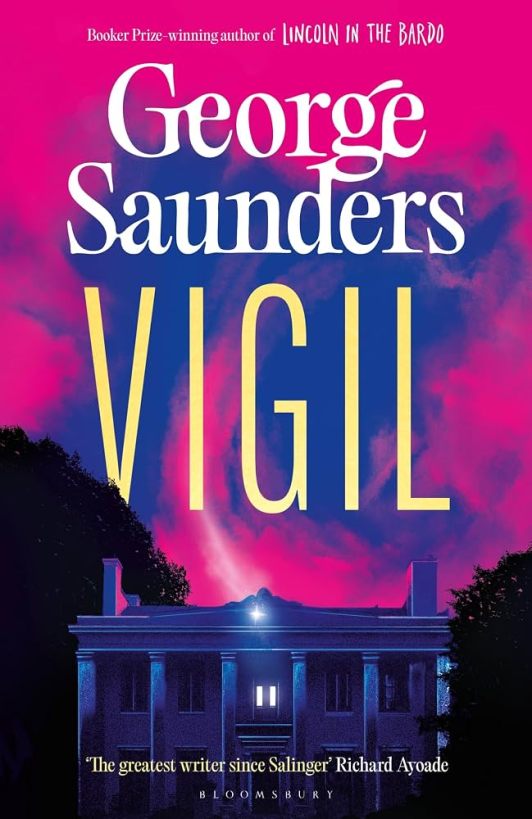
I had never read anything by Saunders before, but I picked this up on a pretty strong recommendation from an article in the Guardian, and because the subject matter (how a supposed ‘captain of industry’, in this case an oil tycoon, negotiates the knowledge that their actions have doomed human civilization) is utterly fascinating to me.
I do not think I will be reading another book by Saunders so readily.
The writing here was just not very good. I don’t really know how else to say it. And the narrative simply wasn’t strong enough to propel the rest of the book. Let’s have a look:
So you’ve said, I said.
Quelle horreur! he cried.
So you’ve said, I said.
That’s fucking awful. It’s not cute, and it’s cacophonic to my ear. Had I wanted to transcribe a few sentences more, you would have had 5 more ‘saids’. I am by no means in the “‘said’ is dead” camp of writing theory, but there were pages where said terminated practically every line.
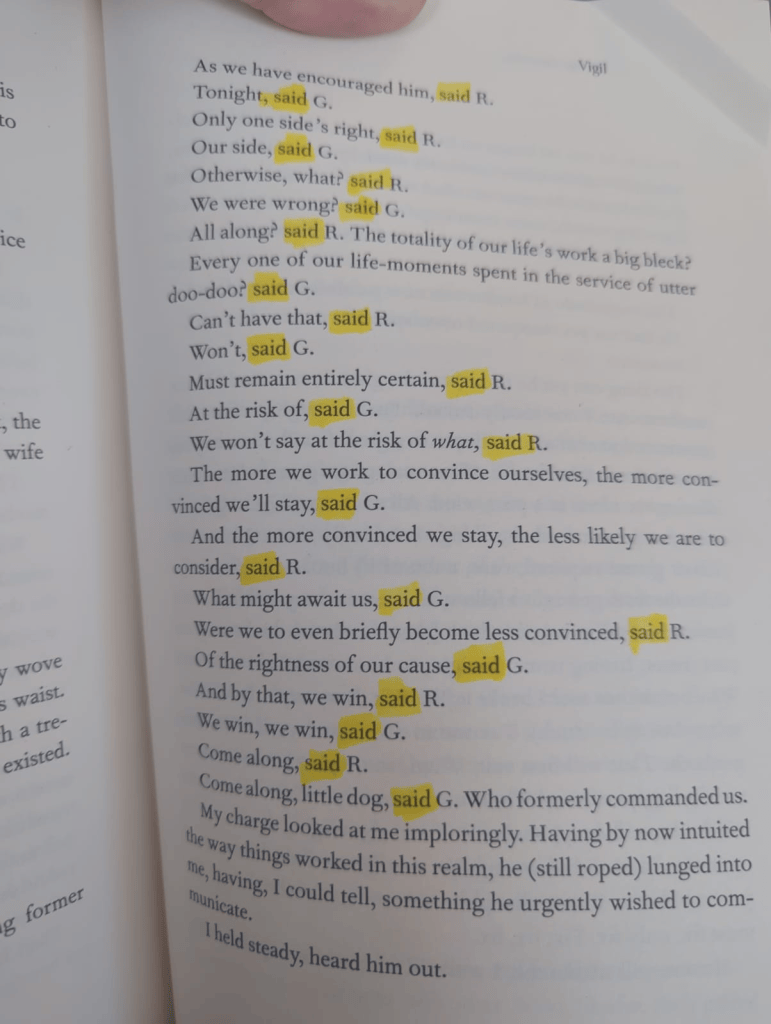
On top of that, I do not know or understand by what magic Cormac McCarthy gets away with omitting his quotation marks, but he manages to makes it work without losing me. Saunders managed to confuse me a few times, and this was because the writing was plain and simple bad. The difference is that everything else in Cormac McCarthy is clearly meticulously crafted. Everything here is not.
A friend of mine recently put her writing into ChatGPT to ask for writing advice. The advice that came back was annoying, but unfortunately accurate: some parts were over detailed, other under detailed. In other words, she seemed to be focusing on the wrong details. So does Saunders, but I didn’t have to pay almost 20€ to read her wrongly detailed book. Saunders introduces to characters in this book at the same time, tells us that they are both named Mel, then refers to them as R. and G. (Rosencrantz and Guildenstern, I suppose).
Or there was this gem:
…white people, brown people, red people, gay folks, those two indistinguishable black (or Black, she guessed you had to say now) waitresses… (pg. 131)
Is there some pronounces difference between black and Black? does one go about and say them differently?
That focus on pointless superfluous detail condemns the book elsewhere. Here are two lines I noticed:
It was Dell cherry-picked that zinger. (pg. 89)
Here, I am willing to give the author some benefit of the doubt. Books are an industry, with a lot of sleepy or hungover or overworked humans in the mix. Someone should have caught it, but not one did. Who hum.
However:
At the U. of. (pg. 148)
I cannot under any circumstance accept this as a typographical error. Nor should i fucking have to have the immersion of a reading experience broken by my sitting on a couch trying to analyze one sentence. Short of some kind of corporate sabotage, this is just fucking dumb. For context, this line come from the internal monologue of a character, who is seeing the ghost of someone from his past. I assume they met at University, and that is the U in question. No one speaks like a paranoid diarist in their own head. Can you fucking imagine if I saw an old friend of mine and in my own head said: “Hey it’s old whats-her-fuck from when I used to [REDACTED] at [REDACTED].
This line exists because Saunders wrote this fucking thing in half an hour, but no effort into it, and the publishers didn’t bother to fucking read it. They thought to themselves “Saunders makes money. Lol hit print.” They didn’t bother to go back and fill in his shorthand.
I could have ignored all of this, but the book had absolutely fucking nothing interesting to say. The oil tycoon considers he could have been wrong right at his death bed (pg. 143), changes his mind a few lines later, and then realized he was wrong definitely (pg. 160) as Rosencrantz and Guildenstern are pulling him off to… I suppose hell, but the world building on this was just off. It felt like Saunders didn’t have the courage to have a strong opinion.
I am always willing to reconsider any opinion I hold, but changing my mind here will require some Herculean convincing. Goodreads thinks that the writing was beautiful. I didn’t think so. If you thought the writing was nice, leave a comment with an example. The only way this makes sense to me would be if I had somehow gotten a first draft that somehow went to the publisher.


